Kaise Chal Raha Hai?
A brand-new footpath, three months, and a steady supply of things I would rather not have noticed. The rulebook exists, by the way. Nobody walks it.

When the road outside started getting a new footpath, I was genuinely happy. Wide, level, new. The kind you see in a builder’s brochure, right next to the swimming pool nobody will use.
The happiness was short-lived. Over the next three months I started noticing things I would have very happily gone on not noticing.
Month one: spikes, for bad trips
Every 20 metres or so, a short steel rod started sticking out of the ground at ankle height. Ribbed, rusty, the works. (Yes, TMT. Possibly the same Indus 555D you’ve seen advertised on the back of every other auto in Bangalore. Why a B2B steel brand markets itself to the guy stuck behind an auto at Silk Board is beyond me. But I digress.)
Nobody asked what they were doing there, or how dangerous they were on a footpath this crowded. Passers-by noticed, hopped over, a few tripped, dusted themselves off and moved on with their busy lives. This is Bangalore. Nobody has time to fall properly.
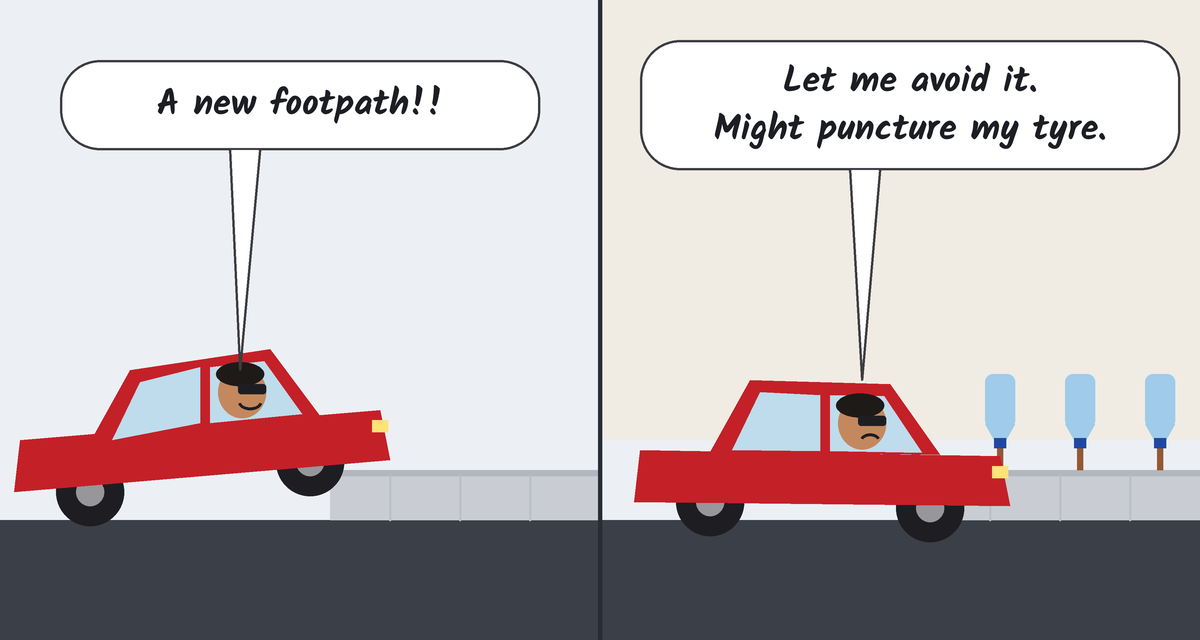
Then the street vendors stepped in. The same vendors who already occupy half the footpath started pushing empty plastic bottles onto the rods. 👏🫡
On Indian roads there is no shortage of citizen contractors (also citizen traffic cops, citizen civil engineers, citizen-<add your role here>). They jump in part-time, do what’s needed, and don’t once glance at their watch. In this case the part-timers were the encroachers, putting a cherry on top of the hafta they (allegedly) already pay to someone in the same food chain as the actual contractor.
Month two: lights, for the trees
The mystery solved itself two months in. The rods were anchors for light poles, which finally showed up. The lights came on about 15 days after that. (If a model took 75 ms to return its first token, my boss would call it broken. Here, 75 days is called phase two.)
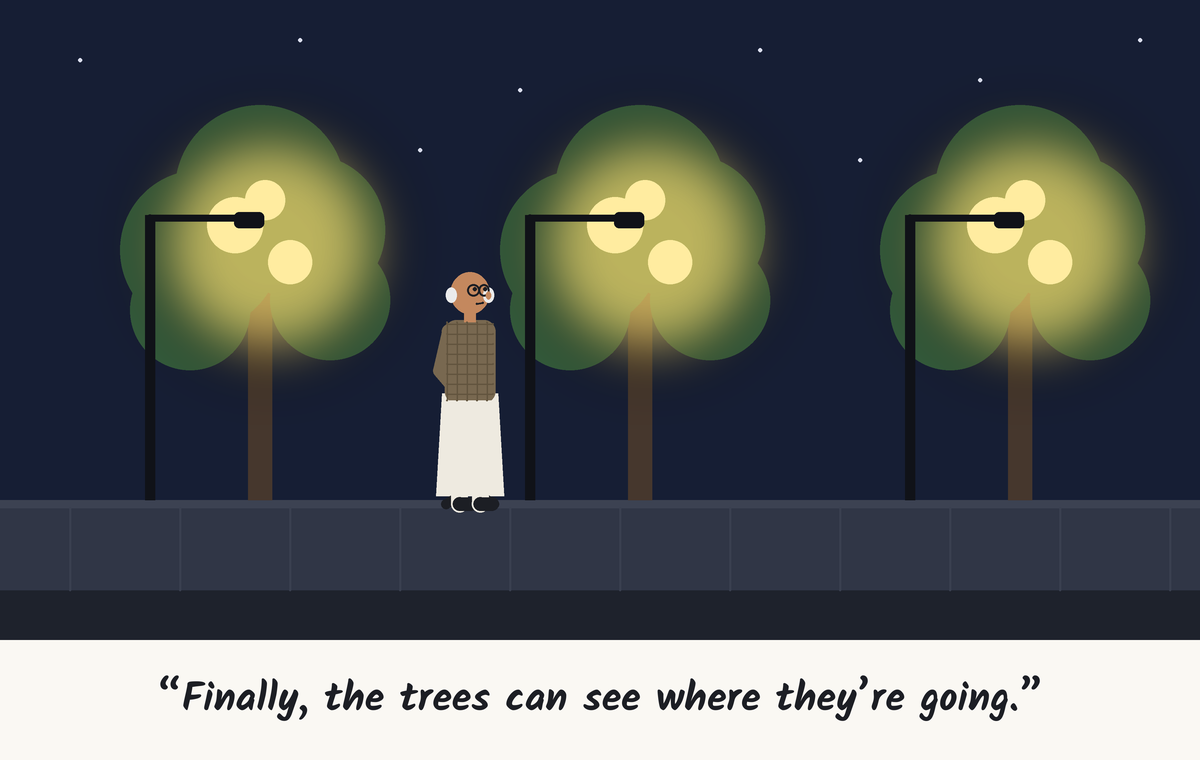
The footpath was built around the existing trees, which is genuinely nice. The poles, though, came out taller than the lower branches, and nobody seems to have checked. So the lamp heads now sit inside the canopy. At night the street has a row of beautifully lit trees above a footpath that is still dark.
Month three: the cracks
Three months in, the new surface is already breaking up. No truck drove over it, nobody dug it up for a cable. People just walked on it, which, last I checked, was the brief.
Concrete and cement tiles can easily last 30 years. Just not when the job is done as a chore, by contractors and labourers who own the solution but not the problem. (Hold that thought. It comes back at the end.)
Who writes the playbook?
My first guess was that nobody does. That’s wrong. The Indian Roads Congress, the body that writes road standards for the whole country, published IRC:103, Guidelines for Pedestrian Facilities in 2012. It is specific, and it reads like it was written by someone who walks.
| IRC:103 (India) | Typical US practice | What Bengaluru got | |
|---|---|---|---|
| Kerb height above the road | 150 mm at most (IRC:103) | 6 inches, about 150 mm (US federal standard drawing) | A new footpath in CV Raman Nagar came out between 3.5 and 5 feet high (The News Minute) |
| Clear walking width | 1.8 m, so two wheelchairs can pass; 2.5 m in commercial areas (IRC:103) | 36 inches minimum for an accessible route under the ADA | Roughly half, once vendors and parked scooters take their share |
| Clear height and obstructions | 2.2 m of headroom, with no poles, boxes, trees or signs in the walking zone (IRC:103) | 80 inches of headroom under the ADA | Steel rods at ankle height, for two months |
| Ramps at crossings | Kerb ramps no steeper than 1 in 12 (IRC:103) | No steeper than 1 in 12 (US Access Board) | Sometimes. Then blocked with posts (see below) |
Look at the first and last rows again. India’s guideline asks for the same kerb height as an American street (150 mm is 5.9 inches), and the same 1 in 12 ramp. The problem isn’t the standard. It’s that nothing ties the standard to the thing that gets built.
When Citizen Matters asked, engineers in the city’s own road department said Bengaluru didn’t have a footpath guideline at all. Different zones were building to different designs, and the Deccan Herald found kerbs high enough that older people struggled to step up. Residents of the CV Raman Nagar stretch described getting onto theirs as climbing.
The car door test
Every driver here knows what a tall kerb does. You park close to the footpath, open the door, and the bottom of it scrapes the kerb. Or worse, the door opens fine, you get in, and it won’t close. Your weight has pushed the car down an inch, and the bottom of the door now sits below the top of the kerb.
In the US, I parked by rolling forward until the tyre touched the kerb. Every city, every state, same height, so you could park by feel, without ever worrying about the bottom scraping the kerb, because the cars are built for the same standard. That is what a standard actually buys you. You stop having to think about it.
The ramps were just as consistent. The Americans with Disabilities Act (ADA) requires a sloped ramp at crossings, no steeper than 1 in 12, so a 6-inch kerb gets a ramp about 6 feet long. Wheelchairs, strollers, suitcases and skateboards all use the same one.
The ramp paradox
Here the Bengaluru version gets harder, and honestly it’s the one part of this I don’t have a clean answer for.
God forbid anyone builds a gentle slope for strollers. To a two-wheeler, a ramp is an invitation with an RSVP. The worst offenders aren’t the motorbikes, which you can at least hear coming. It’s the delivery riders on rented e-scooters, trying to cut delivery time from 10 minutes to 7. 😅 I like e-scooters. In traffic this loud, a silent vehicle is a small mercy. On a footpath, silent means the first you know of one is a handlebar brushing your elbow.
Bengaluru traffic police booked 12,032 cases of riding on footpaths in just the first five months of 2026. That’s about 80 a day, and only the ones who got caught.
So contractors put up bollards. Bollards stop strollers and wheelchairs too, so a gap gets left for wheelchair access, and riders use that gap to ride straight through. Where the bollards are packed tight enough to work, they also make the footpath hard to walk on, and the riders go back onto the road, often against the traffic. The behaviour doesn’t change. It just moves somewhere more dangerous.
What it costs, and what it costs not to
Bengaluru’s gold standard for rebuilding a street is Tender SURE: wide footpaths, with ducts underneath for cables and pipes, so nobody has to dig the footpath up again.
| What | Amount | Source |
|---|---|---|
| Tender SURE rebuild | About ₹10 to 12 crore per km. The 10.61 km around Majestic and KR Market was first reported at ₹130 crore; the state cabinet later approved about ₹105 crore | Deccan Herald, Deccan Herald |
| Nine high-density corridors, Tender SURE style | ₹273 crore for 110 km of footpaths (plus 44 km of asphalting) | Deccan Herald |
| Footpath upkeep, per ward | ₹25 lakh a year, in the 2023-24 city budget | Citizen Matters |
| Fixing 15 wards properly | ₹93.17 crore for every footpath and junction, per a 2023 citizen audit priced at the city’s own rates | Deccan Herald |
The per-km figure is my arithmetic from the project totals, not a number the city publishes. The line to sit with is the third one. ₹25 lakh a year, for every footpath in a ward. That’s less than the on-road price of a mid-size SUV, the kind currently parked on said footpath.
And the cost of not doing it: in 2023, Bengaluru recorded 292 pedestrian deaths, the most of the 53 cities in the NCRB’s data. Ahmedabad was a distant second at 236.
Someone in India already solved this
The railways.
Indian Railways runs about 69,000 route km of track, in the same heat, the same monsoon and with the same budgets everyone else here works with. Its rulebook, the Permanent Way Manual, says every stretch of track is inspected on foot, every day, by a keyman: one named person responsible for that beat. On top of that there are patrols after heavy rain, night patrols through the monsoon, and hot-weather patrols for welded rail, which can buckle. Findings get logged.
None of it is exotic. It’s a person, a beat and a schedule (a human in the loop, literally walking the loop), applied to something far more complicated than a footpath.
A footpath here, instead, belongs to everyone in slices. The city’s road engineers build the slab. BESCOM supplies the power for the lights. Someone else handles trees. Traffic police deal with riders and parking. Each slice has an owner. The walk itself doesn’t.
When the city does act, it acts as a campaign. In July 2026 a ten-day “Safe Footpath” drive cleared encroachments from 202.7 km of footpaths in its first three days. That’s real work. It’s also a drive, and drives end. Some vendors were back in the same spots within hours, and the minister has since had to order fines and FIRs for repeat offenders.
Asking for the records
An RTI costs ₹10, and Karnataka takes applications online at rtionline.karnataka.gov.in. For a footpath like this one, the useful questions are:
- the work order and drawings for the stretch, including the specified kerb height and width;
- the contractor’s name and the defect liability period, which is how long they must fix defects at their own cost;
- the quality inspection reports, and who signed them;
- when power was requested for the new poles, and when it was connected.
The third one is the interesting answer. If someone signed off on this footpath, they either measured it or they didn’t. I’ve added filing this RTI to my agent’s backlog. (It’s a better use of an AI agent than yet another to-do app.)
The prompt, if you want to file your own
You are helping a Bengaluru resident file RTI applications under the
RTI Act, 2005, to the Public Information Officer of [city corporation],
Greater Bengaluru Authority.

The footpath: [road name], from [landmark] to [landmark], built between
[month, year] and [month, year].

Karnataka's RTI rules expect one subject per application, in about
150 words. So draft four separate applications, one for each:
1. The work order, approved drawings, and specified kerb height and
   clear walking width for this stretch.
2. The contractor's name, contract value, and defect liability period.
3. Quality inspection reports for the work, with the names and
   designations of the officers who signed them.
4. The dates on which power connection was requested and granted for
   the new street lights on this stretch.

Ask for certified copies, and for inspection of files if copies are not
available. Plain language, no adjectives, no opinions. Flag anything
I need to fill in before filing.
What a fix would look like
Turn the Ship Around is David Marquet’s account of taking command of the USS Santa Fe, a US nuclear submarine ranked near the bottom of its fleet. He’d spent a year preparing for a different submarine, so he didn’t know this one well enough to run it by giving expert orders. So he flipped the model. The usual setup is leader-follower: the captain gives orders, the crew carries them out. Marquet moved to leader-leader: officers came to him saying “Captain, I intend to…”, he asked questions until he was confident they’d thought it through, and then he said “Very well.” Within about a year, the Santa Fe went from among the worst-rated boats in the fleet to among the best.
Footpath crews work in leader-follower mode, or more precisely leader-follower labourer. The drawing says a rod goes here, so a rod goes here. It’s nobody’s job to ask what happens to the person walking past it at 7pm for the next eight weeks.
The same crew in leader-leader mode sounds like this:
- “I intend to cap these rods with plastic sleeves today, since the poles aren’t due for two months.”
- “I intend to move this pole two metres along. Otherwise the lamp ends up inside that tree.”
Neither needs new money. Both need a crew that has been told the purpose (people walk here, including at night, including people who can’t see well) and is allowed to act on it.
Marquet is careful to say that handing over control only works alongside two other things: competence, and clarity about the goal. Give a crew control without a clear standard and you get a different footpath on every street, which is pretty much what Bengaluru has now. The clarity half already exists. It’s IRC:103, sitting in a PDF.
If only one thing changes
A keyman for footpaths. One named person for every kilometre, who walks it every week while it’s being built and for years afterwards, and logs what they find somewhere the public can read. Put their phone number on a board at each end of the stretch, title it Kaise chal raha hai?, and borrow the line every office cab carries for the cars behind it: In case of rash driving, call XXX. For a footpath: In case of a “bad trip”, call XXX. 🙂