The Singularity Is Nearer
A book that predicted human-level AI by 2029, back when that sounded silly. Its sequel bets on nanobots, endless lifespans and a basic income for everyone. Do these bets work in the Indian market?
In 1999 Ray Kurzweil said a computer would hold its own in conversation with a human by 2029. Many AI researchers at the time thought that was decades further out, if it happened at all. In 2026 he looks early, if anything. Models that can hold up their end of a conversation are routine, AGI is more or less proven, and the argument has moved on to what comes after it.
His 2005 book, The Singularity Is Near, made that case at length. It argued that computing, genetics, nanotechnology and robotics were all improving exponentially, and that together they would reach a point where human and machine intelligence merge. He called that point the Singularity and put it in 2045. The book was written before the iPhone, for readers who thought AI was a research curiosity, so much of it is charts and technical argument meant to win over skeptics.
The Singularity Is Nearer (2024) is the sequel, written after ChatGPT. With far fewer skeptics left to convince, it spends less time on proof and more on what life looks like once the predictions come true. Both dates stay where they were: human-level AI by 2029, and the Singularity by 2045.
What the Singularity means
Humans are restricted to thinking with whatever fits inside one skull. All other knowledge has to come in through an interface: a phone, a laptop, a search box, a book. The interface is slow. You think of a question, unlock the phone, type, read, and only then does the answer become part of your thinking.
The Singularity, in the book’s sense, is the point where that interface disappears. The brain connects directly to computing in the cloud, the way a laptop reaches a server, and thinking stretches beyond the skull. He expects this to multiply our intelligence about a million times. Looking something up would feel the same as remembering it.
Skills could work the same way. You could probably download one in minutes. Anyone who watched Chuck will remember the Intersect, a government database that ends up inside an electronics store clerk’s head. One “flash” and he could speak a language he had never studied or win a fight with a martial art he had never trained in. A skill that takes the rest of us years, he picked up in seconds.

That is still fiction, but the first step is real. Since 2024, people with paralysis who have Neuralink brain implants have moved a cursor and played chess online just by thinking about it. Going from a cursor to kung fu is a long road. The book thinks it takes about twenty years.
The math behind his predicted dates is what he calls the Law of Accelerating Returns (LOAR). The name is a play on a rule you might have come across, the law of diminishing returns: keep adding more of one input, like workers to a factory floor or fertiliser to a field, and each extra unit gives you less than the one before. The tenth worker adds less than the first because they’re all sharing the same machines.
Technology, he argues, works the other way. Each generation of technology is used to build the next one: faster chips help design even faster chips, and better AI helps train better AI. So each step gives you more than the one before, and progress doesn’t add, it compounds. Computing power per dollar has followed a smooth exponential curve for more than 80 years, through vacuum tubes, transistors and chips, regardless of wars or recessions.
Exponential growth is hard to feel. Anything that doubles every year grows about a thousand times in 10 years, and about a billion times in 30. For most of that curve nothing seems to happen. Then everything happens at once, which is roughly how the last three years of AI have felt.
Three takeaways
1. Nanobots, longer lives and vertical farming
Nanobots are machines the size of a blood cell, living inside your body. They would report on what’s happening in real time, and repair or replace cells as they wear out. Ageing, in this view, is accumulated damage, and damage can be fixed if you can reach it.
That sounds like science fiction until you look at what is already being built atom by atom. Lab-grown diamonds are made by laying down carbon one layer of atoms at a time, and are now chemically identical to mined ones and far cheaper. It’s a small step, but it’s the right kind of step: manufacturing at the scale of atoms, done reliably and cheaply.
Then there’s longevity escape velocity. Today, each year of medical progress gives back about four months of life expectancy. Kurzweil expects that by the early 2030s, AI-driven research will give back more than twelve months a year (in interviews he has said as soon as 2029). Past that point, the longer you live, the longer you can expect to live. Which leads to the boldest claim in the book: the first people who will never die of an age-related disease have likely already been born.
If even half of this arrives, healthcare and insurance get turned upside down. Health insurance today mostly pays to fix things after they break. A body that reports on itself every second makes it cheaper to pay for prevention. Life insurance and pensions are priced on how long people live, and both stop working if that number keeps moving.
Vertical farming is another example from the book, and a nearer one.
Farming today is limited by two things it can’t control: how much land you have, and the weather. Some crops die when the rain fails. Others rot when it comes too hard or too late. A whole season’s work can be undone in a week.
Part of that limit has already been broken. Hydroponics grows plants without soil, with roots sitting in water that carries exactly the nutrients they need, and hydroponic lettuce, herbs and microgreens are already on supermarket shelves in Indian cities. The book’s prediction goes further: most crops grown indoors, in layers stacked several floors high, under LED light. AI manages the water, nutrients and climate for every tray. Think of them as data centres for farms. They use a fraction of the land and water of an open field, don’t depend on the monsoon, and can sit next to the city that eats the food. The book expects this to push food prices sharply down.
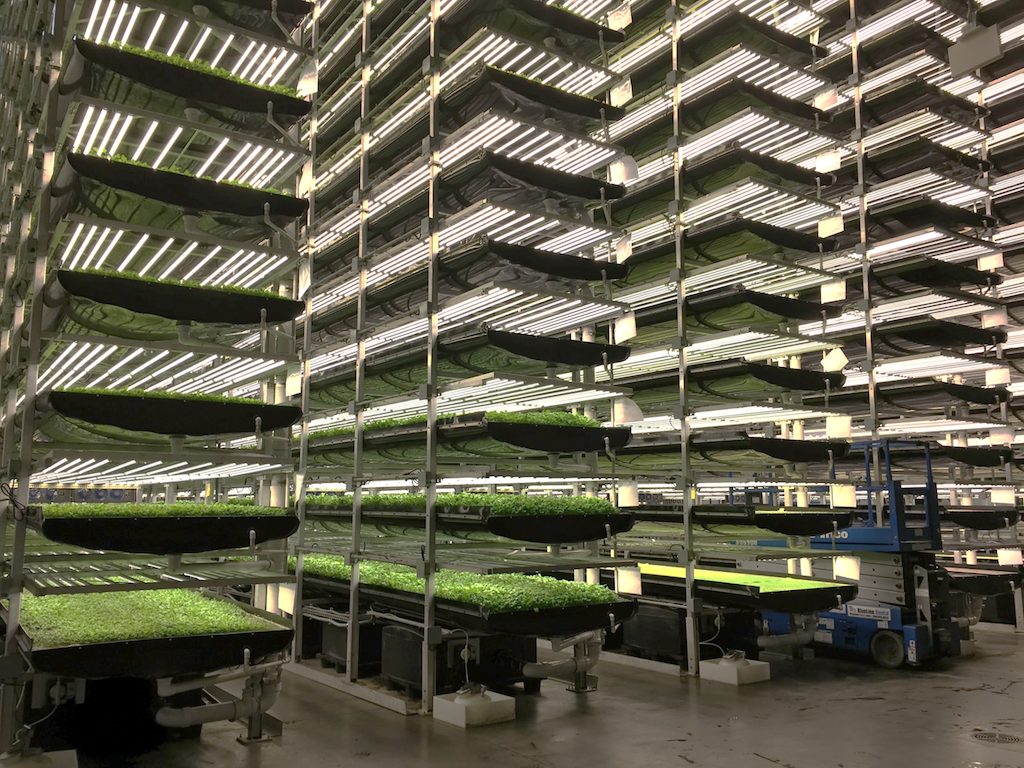
Today the economics only work for leafy greens and a few high-value crops. Wheat and rice still need open fields. But in India this isn’t a gadget story. In 2022, 11,290 farmers and farm labourers died by suicide, about one every hour, and crop failure and debt are recurring reasons. Land is the other problem. 86% of farm holdings are under two hectares, the average is about one hectare, and ownership disputes over that land can run for generations. Farming that doesn’t depend on owning large plots, or on the rain, changes who can farm and how much risk they carry. It won’t fix debt or crop prices by itself, but it removes the two things farmers can least control.
2. Universal Basic Income
Universal Basic Income (UBI) means the government pays every adult a fixed amount every month, no conditions attached. The book expects every developed country to have one by the early 2030s, and developing countries by the end of that decade. His reasoning is that AI will make goods and services so cheap that funding it becomes easy.
I love the idea. When rent and groceries are covered no matter what, people can afford to retrain, start something, or care for a parent. But it’s built for countries with a large tax base, a small gap between rich and poor, and a small population. India has none of these. Here are the numbers:
| India | United States | |
|---|---|---|
| GDP per person (2025) | about $2,800 | about $89,000 |
| People | about 1.45 billion | about 340 million |
| The nearest thing to a cash income for all | PM-KISAN: ₹6,000 a year (about $70) to about 95 million farmers | Alaska: $1,000 to every resident in 2025, $1,702 in 2024 |
The average American produces about 30 times what the average Indian does, and India’s income is far more lopsided: the top 10% of earners take 58% of national income, and the bottom half gets 15%.
India actually ran the numbers. The government’s Economic Survey 2016-17 costed a UBI that would lift everyone above the poverty line: ₹7,620 a year per person, about ₹635 a month, or well under $10. Paid to 75% of the population, it would cost 4.9% of GDP. Everything the central government spent on its roughly 950 welfare schemes that year added up to 5.2% of GDP. So India could afford a poverty-line UBI only by shutting down almost every other scheme to pay for it.
For comparison, Finland’s 2017-18 trial paid €560 a month, more than 80 times India’s figure, and only to 2,000 unemployed people.
The idea isn’t the problem. A pilot in Madhya Pradesh between 2011 and 2013 gave about 6,000 villagers ₹200 to ₹300 a month. Debt fell, children ate better, and more girls stayed in school. It worked in a village. The problem is scale: 1.4 billion people, a thin tax base, and income concentrated at the top. The book’s answer, that AI makes everything so cheap that money stops mattering, assumes the cheapness reaches everyone at the same time.
3. Boomers and doomers
Earlier this year I read Karen Hao’s Empire of AI, which follows the split inside AI labs between two camps. The doomers, many tied to the effective altruism movement, believe advanced AI could end humanity and must be slowed down or tightly controlled. The boomers believe it will mostly make life better and want to build faster. (Boomer here has nothing to do with age.)
Kurzweil is a boomer, and so am I. The book gives the risks one chapter out of eight, titled simply “Peril”: AI that pursues the wrong goal, engineered pandemics, nanotechnology gone wrong. He takes them seriously, but the rest of the book plainly doesn’t expect them to win.
That imbalance is the most common complaint in the reviews, and it’s fair as far as it goes. One chapter is thin for a technology its own builders say could be dangerous. But every big technology arrived with its own doomers. In 1975, biologists worried about genetic engineering met at Asilomar in California and wrote rules for their own research before any government asked them to. Aviation became the safest way to travel because every crash produced a new rule. Problems that look unsolvable at the start of a technology tend to look like engineering problems from the middle of it.
The harder problem is quieter than extinction. It’s the one in the second takeaway: the benefits arrive, but arrive unevenly, and a country with the world’s largest young workforce could end up on the wrong side of the curve.
I’m not worried about that either. Humans are good at solving problems once we can see them coming, and this one is in plain sight. All izz well.